
How to Get Your Business Recommended by ChatGPT and Cited in AI Overviews
- Customers now ask ChatGPT and Google's AI which local business to use. Those tools answer by naming specific businesses and citing specific websites. If you are not the cited source, you are not in the conversation.
- This is not a new trick. It is solid SEO fundamentals pointed at questions instead of keywords. If you have avoided SEO because it felt like gaming a system, this is the version that is just being genuinely useful.
- Our results across two client sites: 91 different questions where Google's AI cites the client, and on 82 of them the client is the first source named. That is a 90 percent first-citation rate.
- One of those sites launched in spring 2026 and earned 21 citations within six months, so you do not need an old website or a big backlink profile to start.
- The method is four steps: write down the questions customers actually ask you, answer each one completely on its own page, put the answer at the top, and link the related pages together.
Right now, someone in your area is asking ChatGPT which business to call. Someone else is typing a question into Google and getting an AI-written answer at the top of the page, above the ads, that names a specific company and links to a specific website.
Those tools are not guessing. They are pulling from websites that answered the question clearly. One of those websites gets named. The rest do not exist as far as that customer is concerned.
We have spent the last year getting our clients named. This article is how it works and how you can start doing it.
The good news: this is not a new trick
If you have kept SEO at arm’s length because it always sounded like gaming a system, here is the part worth hearing.
Getting recommended by AI is solid SEO fundamentals aimed at a slightly different target. Clear page structure. Real expertise from someone who actually does the work. Fast, clean pages. Sensible links between related pages. Every one of those mattered five years ago and every one of them still matters.
What changed is the target. Traditional SEO chases a keyword and tries to rank a page for it. This chases a question and tries to be the best answer to it. That is a friendlier goal for a small business owner, because you already know your customers’ questions. You answer them on the phone every week.
You are not learning to manipulate an algorithm. You are learning to write down what you already know, in a form a machine can quote.
What we have actually done
We do not want to hand you theory. Here is the measured result across two client websites in two different industries:
- 91 separate questions where Google’s AI cites the client’s website
- 82 of those citations name the client first, ahead of every other source listed
- 21 of them were earned by a site that had only been live for six months
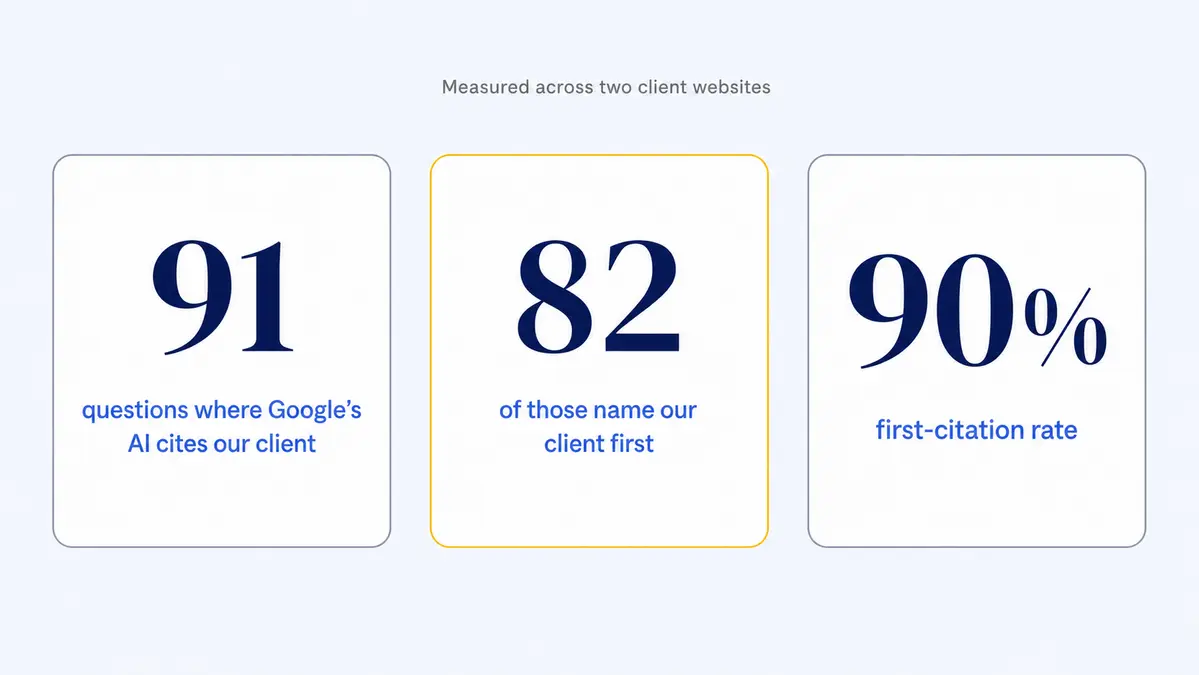
That 90 percent first-position rate is the number that matters. An AI answer usually lists a few sources. Being somewhere on the list is visibility. Being the first one named is being the recommendation.
Getting mentioned once is luck. Being named first across 91 different questions is a system, and a system is something we can repeat for another business.
The core idea: answer the questions your customers ask
Everything below follows from one sentence.
Be the best answer to the questions your customers ask before they buy.
That is it. Not the most keywords. Not the most pages. The best answer.
Think about what people ask you before they hand over money. A landscaper gets asked whether sod or seed makes more sense for a yard. A dentist gets asked whether a crown or a filling is the right call. An HVAC company gets asked whether it is smarter to repair a fifteen-year-old system or replace it. A law firm gets asked what happens in the first week after an accident.
Those questions get typed into ChatGPT and Google every single day. Somebody’s website is being quoted as the answer. There is no reason it should not be yours.
The insight most businesses miss
Here is the finding from our client data that changes how you should think about this.
On one client site, a single page is cited first for all four of these searches:
- “which is better north carolina or south carolina”
- “which is better north or south carolina”
- “which is better south carolina or north carolina”
- “which is better: north or south carolina”
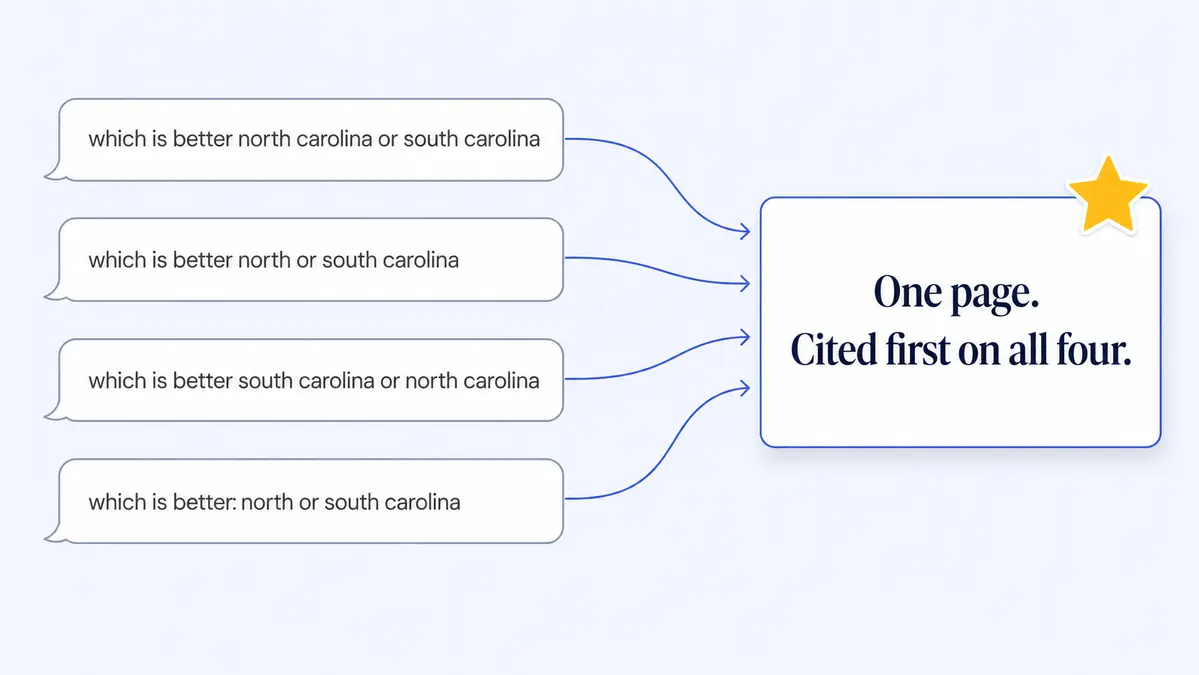
Four different ways of typing the same question. One page. First result every time.
That pattern repeats across the data. Another page holds the first citation across five phrasings of the same question. A third does it across three.
Why this matters to you: the old SEO playbook would have built four separate pages, one per wording, each one thin and competing with the other three. That splits your effort four ways and gives the AI four mediocre options instead of one good one.
AI tools do not match the exact words. They work out what is actually being asked, then look for whoever answered it best. So you do not need to guess how someone will phrase it. You need one genuinely complete answer.
For a roofer, that means you do not need separate pages for “roof repair cost,” “how much does roof repair cost,” and “average cost to repair a roof.” You need one honest page about what roof repairs cost in your area that actually answers the question. It will pick up all three.
That is a much smaller job than most SEO advice makes it sound.
The four steps
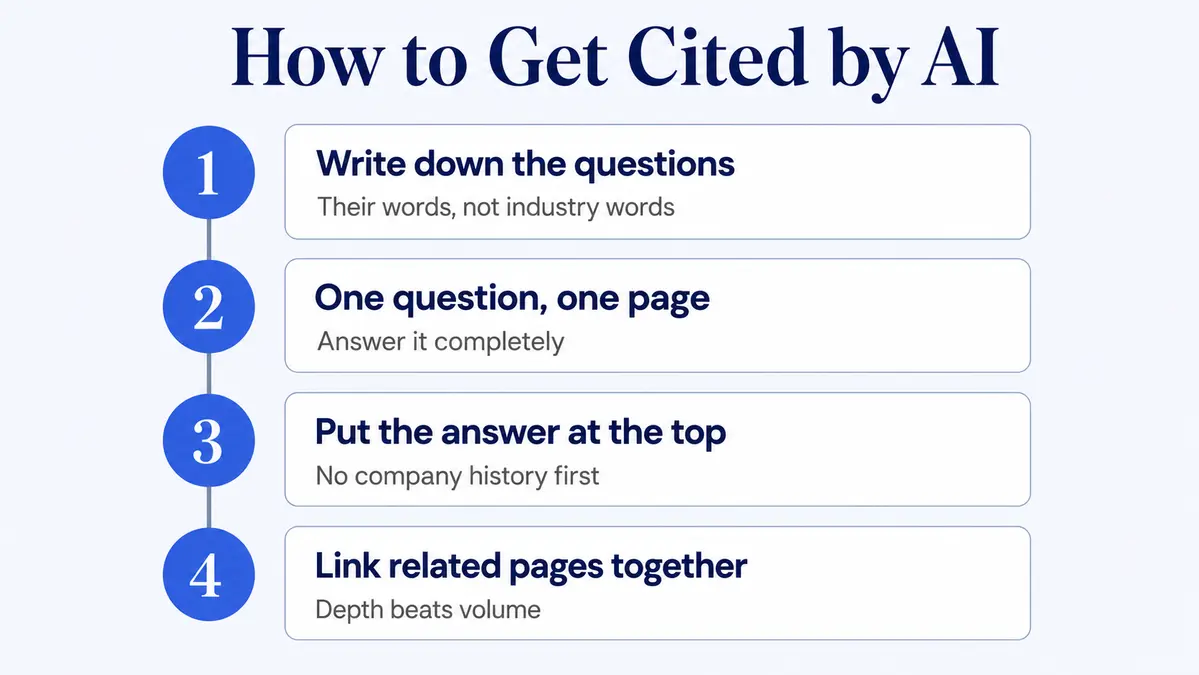
1. Write down the questions, not keywords.
Sit down for twenty minutes and list every question a customer asks you before they buy. Use their words, not industry words. If you cannot say the question out loud the way a customer would say it, it is not ready.
This list is worth more than any keyword tool, because you already know things a tool cannot: which questions come up right before someone commits, and which answers actually change their mind.
2. Give each question its own page, and answer it completely.
One question, one page, a real answer. Not a teaser that pushes a contact form after two sentences.
This is where most businesses flinch. Giving away the answer feels like giving away the reason to call you. It is not. The business that answers the question is the business that gets the call, because you just proved you know what you are talking about while your competitor is still hiding behind “contact us for a quote.”
3. Put the answer at the top.
Do not open with your company history. Open with the answer, in the first sentence or two, in plain language. Then follow with the detail, the caveats, and the reasons.
An AI tool scanning your page is looking for a clean, quotable answer. If it has to dig past three paragraphs of introduction, it will quote whoever made it easier.
This helps human customers too. Nobody has ever been annoyed by getting their answer quickly.
4. Link the related pages together.
When you answer a question, link to the two or three related questions you have also answered. This is how a handful of pages turns into demonstrated depth on a topic instead of a pile of disconnected articles.
It is also why results tend to speed up over time rather than trickling in. Each solid answer strengthens the ones around it.
What kinds of pages actually win
Looking at where the citations landed across our client sites, the pattern is consistent and probably not what you would expect.
Informational pages did the heavy lifting. Guides, explainers, and local updates earned far more citations than the sales pages did. The pages that answered something outright beat the pages that pitched.
Translated to your business:
- A page explaining one specific service in real detail, including what it costs and when it is not the right choice
- A guide for people who are new to your area or new to your type of service
- An honest comparison between two options you offer, including when the cheaper one is genuinely the better call
- A plain answer to the question you are tired of answering on the phone
Your sales pages still matter. That is where people contact you. But they are almost never what earns the AI citation, because everybody’s sales page says roughly the same thing. The pages where you actually explain something are the ones that are truly yours.
About the size of these searches
Worth being straight with you, because a lot of marketing material is not.
The typical question earning our clients a citation gets around 90 searches a month. That is not a huge number and we are not going to dress it up as one.
But that is the strategy working exactly as intended. Nobody local wins the giant generic search terms, and those terms are full of people who are just browsing. Someone typing a specific, detailed question is close to making a decision. Ninety of those a month, where you are the named answer, is worth considerably more to a real business than a sliver of a term you were never going to rank for.
Comprehensive coverage of the questions that matter beats a trophy keyword you cannot win.
How to know if it is working
Two things to watch, and they tell you different things.
Google Search Console has a report called “Generative AI features.” It shows how often your site appears inside AI answers. That tells you volume. One of our client sites shows 450 to 500 appearances a day there.
Citation position is the other half, and Search Console does not show it. You need a tool that records which sources an AI answer cites and in what order. This is where our 90 percent first-position figure comes from.
You want both, because they can disagree. You can show up constantly and always be the fourth source listed, which is a very different situation from being the first.
Where to start this week
Pick the single question you get asked most often. Not the one with the best search volume. The one you answer out loud every week and could explain in your sleep.
Write the page that answers it properly. Answer at the top. Real detail underneath. Then write the two or three questions that naturally come next and link them together.
That small cluster is your test. In most local markets it works, because most competitors have never written a real answer to anything.
Or we can build it for you
This is what we do. We map the questions your customers are actually asking, build the pages that answer them, structure them so AI tools can quote them cleanly, and track which questions you are winning and where you sit in the citation order.
We proved it in mortgage first, which is the hardest possible testing ground. AI tools apply their strictest source-quality standards to anything touching someone’s money, so if the approach works there it works in an easier category. Then we did it again in real estate on a brand new site with no history at all, and it worked in under six months.
We work with one business per market, no exceptions. If a competitor in your area gets there first, we will not take you on.
Take a look at what answer engine optimization involves, or check whether your market is available.
Want the detail behind the numbers?
- The real estate case study documents the new-site result, 21 citations within six months of launch
- The mortgage case study documents the established-site result, 70 citations at a 94 percent first-position rate, plus 450 to 500 daily AI appearances
- How AEO is changing mortgage marketing covers this shift for lenders specifically