Real estate AEO case study

A New Real Estate Website Earned 21 AI Overview Citations in Under Six Months

Client name omitted for privacy | South Carolina market | Measured August 2026

Quick Summary
  • A South Carolina real estate website launched in spring 2026 and, in under six months, earned 21 distinct Google AI Overview citations.
  • On 16 of those 21 queries the site is the first source the AI Overview cites, ahead of every other result. That is a 76 percent first-citation rate on a brand new domain.
  • The median cited query gets roughly 90 searches per month. This is long-tail question coverage, not competition for high-volume head terms.
  • Community and neighborhood guide pages produced most of the citations. Informational content earned the AI visibility, and the property pages benefit from the authority it built.
  • The same approach on an established mortgage site produced 70 citations at a 94 percent first-citation rate, which suggests this compounds rather than plateaus.
  • Answer Engine Optimization is the practice of structuring content so AI answer engines cite it directly. It is the core of every engagement at Tim Armstrong Marketing.

The usual objection to answer engine optimization is that it only works for sites that already have authority. This project is the counterexample. A South Carolina real estate website went live in spring 2026 with no existing domain authority, no backlink profile, and no history. Within six months it was being cited inside Google AI Overviews on 21 separate questions, and on 16 of them it was the first source cited.

21

Distinct queries where a Google AI Overview cites this site

76%

Of those citations place this site first, ahead of every other source

< 6 mo

From site launch to the citation footprint measured here

90/mo

Median search volume per cited query. Long-tail coverage by design

What an AI Overview Citation Actually Is

An AI Overview citation is when Google's AI-generated answer names your page as one of the sources it used. The citation appears above the paid ads and above every organic result, which means the cited business is the first name the searcher sees, before they scroll and before they encounter a competitor.

This matters more in real estate than in almost any other local category, because buyers ask a long series of questions before they ever look at a house. What is this community like. Which neighborhoods are inside it. Is it a good place to retire. Whoever answers those questions is present at the start of the decision, not at the end of it, and being present early is what a listing feed can never buy.

There is a second reason it matters for a new site specifically. Ranking on page one of organic results takes time and links. Being cited in an AI Overview depends more on whether a page cleanly answers the question than on how old the domain is. That gap is the opening a new site can use, and it is exactly what happened here.

The mechanic

One Page, Every Phrasing of the Same Question

The single most useful pattern in this data set is what happens when a page genuinely answers one question. It does not get cited for one search term. It gets cited for every way a person might ask that question.

One community guide page on this site holds the first AI Overview citation across three separate phrasings of the same neighborhood question. Another community page does the same across four phrasings of a question about a coastal area. Traditional keyword strategy would have built a separate thin page for each variant, splitting the authority and giving the answer engine no clear best source. Instead one complete answer collected the entire cluster.

This is the practical difference between optimizing for a search engine and optimizing for an answer engine. A search engine matches strings. An answer engine resolves the question behind the string, then looks for the page that answers it best. You do not need to guess the phrasing. You need to be the best answer.

It is also why the median cited query here sits at about 90 searches a month. The strategy is not to win a few large terms. It is to comprehensively own a large number of specific questions that competitors are not bothering to answer properly.

Which Pages Earned the Citations

Almost all of the citations on this site landed on informational content rather than on transactional property pages. That surprises most agents, and it is the most transferable lesson here.

Community guide pages

Dedicated pages answering what it is actually like to live in a specific place. These produced the largest share of citations on this site, because they answer questions no listing feed can answer.

Neighborhood breakdown pages

Pages covering the neighborhoods inside a community, written to resolve the question directly rather than to funnel a visitor into a property search.

Lifestyle and amenity pages

Content covering the specific features buyers ask about before they ask about houses. Answer engines cite these because they contain a real answer, not a call to action.

Relocation and orientation content

Material aimed at people who have not chosen a market yet. This is the earliest point in a buyer journey and the least contested by competing agents.

The property pages are still where inquiries happen. But they are not what earns the AI citation, because syndicated listing data is identical across every competing site in the market. An answer engine has no reason to prefer one copy of the same feed over another. The guide content is the part that is genuinely yours, and it is the part that gets cited.

How the Site Was Built to Earn Citations

There is no single trick behind this. It is four disciplines applied consistently from the first page onward, which is why a new domain was able to do it quickly.

1

Start from real questions, not keyword lists

Every page begins with a question a real buyer asks out loud. Not a keyword with a search volume attached to it. Answer engines resolve intent behind phrasing, so the unit of work is the question, not the term.

2

Answer the question completely, in one place

A page that half answers a question and then pushes a form does not get cited. The page has to actually resolve what was asked, near the top, in language a machine can lift cleanly.

3

Structure the answer for extraction

Direct answer near the top, clear heading hierarchy, FAQ formatting where the content warrants it, and schema markup that tells the engine what the page is. None of this wins alone. Together it makes the page the easiest correct source to quote.

4

Build the surrounding cluster

One answered question links to the related answered questions around it. The cluster raises the topical authority of every page in it, which is why citations accelerate rather than arriving one at a time.

The Difference

Why This Worked on a Six Month Old Domain

A new site cannot outrank established competitors on authority. It can out-answer them on questions those competitors never bothered to address properly.

Built for answer engines
Built for keywords alone

Pages built to answer a question

Get cited as the source inside the AI answer, which appears above the ads and above every organic result. The visibility is earned and carries no per-click cost.

Pages built to capture a keyword

Compete for a blue link position that fewer people reach, on a results page where the AI answer above them has already resolved the question.

One complete answer per question

Collects every phrasing of that question at once. On this site a single community page holds the first citation across three different wordings of the same neighborhood question.

A separate thin page per keyword variant

Splits authority across near-duplicate pages that compete with each other, and gives the answer engine no single best source to cite.

Informational content treated as the asset

Guide and community pages carried the citations on this site. That authority then supports the transactional pages that actually convert.

Listing feeds treated as the content strategy

Syndicated property data is identical across every competing site in the market, so it gives an answer engine no reason to cite one source over another.

The Same Approach on an Established Site

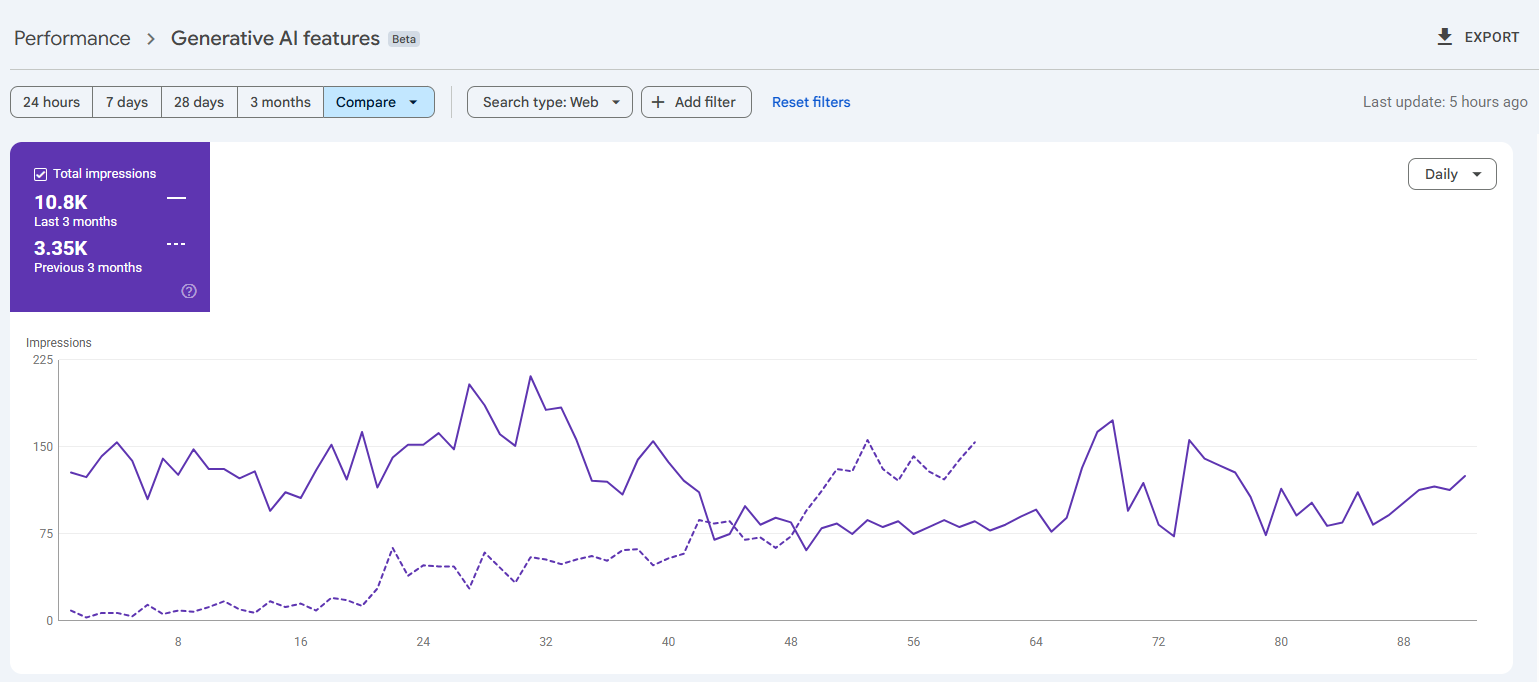
This real estate project shows how fast the approach can start working. A separate South Carolina mortgage client shows what it looks like after it has had time to compound: 70 distinct AI Overview citations, with the client cited first on 66 of them, a 94 percent first-citation rate, alongside 450 to 500 AI Overview appearances per day in Google Search Console.

Two different industries, two very different site ages, the same method. That is the argument for treating this as a repeatable system rather than a lucky result.

Read the Mortgage Case Study

FAQ

Real Estate AEO Case Study FAQ

Is the real estate client identified in this case study?

No. The client name, website, and specific communities covered are intentionally omitted. The state is disclosed because market type is relevant context, but no identifying details are included.

How quickly did this site start earning AI Overview citations?

The site launched in spring 2026 and the citation data described here was measured in August 2026, so the full result was achieved in under six months from launch. That is unusually fast for a new domain, and the reason is that the content was built for answer engines from the first page rather than retrofitted later.

How were these citations measured?

Through a third-party SERP index that records which sources each Google AI Overview cites and in what order. This is a different measurement from Google Search Console, which reports how often a site appears inside AI features but not which position it holds among the cited sources. Both measurements are useful and they answer different questions.

Why does being cited first matter more than being cited at all?

An AI Overview typically lists several sources. The first one carries the most weight with the reader and is the one most likely to be clicked or remembered. Appearing somewhere in the source list is visibility. Being the opening citation is authority, and it is the difference between being one of several options and being the answer.

Does this work outside real estate?

Yes. The same approach on an established South Carolina mortgage site produced 70 AI Overview citations with a 94 percent first-citation rate. The mechanics are not industry specific. Any local service business whose customers ask questions before they buy can use this.

Are these results guaranteed?

No. Results depend on market competition, how contested the questions are, content quality, and how consistently the site is developed. This case study documents what happened on one project. It is evidence that the approach works, not a promise of a specific number.

Why is the median search volume so low on the cited queries?

Because that is the strategy working as intended. High volume head terms are contested by national brands with large budgets. Specific questions are not. Ninety searches a month from someone asking a detailed question about a neighborhood is worth considerably more to a local business than a fraction of a percent of a generic high volume term.

Want this working on your site?

Answer engine optimization is built into every engagement. If your customers ask questions before they buy, those questions are being answered by an AI right now, and someone is being cited as the source. It may as well be you. One client per market, no exceptions.

Mortgage SEO case study: South Carolina mortgage broker

See what happens when a website is actively managed, measured, and improved.

A South Carolina mortgage broker stopped treating the website like a static brochure. By analyzing what was working, improving borrower-intent content, and actively managing the site around real search data, the website grew from 200 to 700+ monthly organic clicks and consistently generated 450-500 AI Overview mentions per day.

200 to 700+

Monthly Google Search clicks, built entirely through organic SEO

$0

Ad spend to generate these visits. Every click is earned, not bought.

450-500/day

AI Overview mentions generated per day

$6.2K-$6.7K

TOTAL Monthly VALUE